Donghwa Hitech Registers Proprietary “Induction Heating-Based Precision Heating Apparatus” for Fabric & Filament Production Processing (Patent No. 10-2941528)
Donghwa Hitech Registers Proprietary “Induction Heating-Based Precision Heating Apparatus” for Fabric & Filament Production Processing (Patent No. 10-2941528)
Updates
“The completion of a sustainable precision control solution. Setting a new standard for chemical and textile processing through reduced heating times and perfect energy efficiency.”
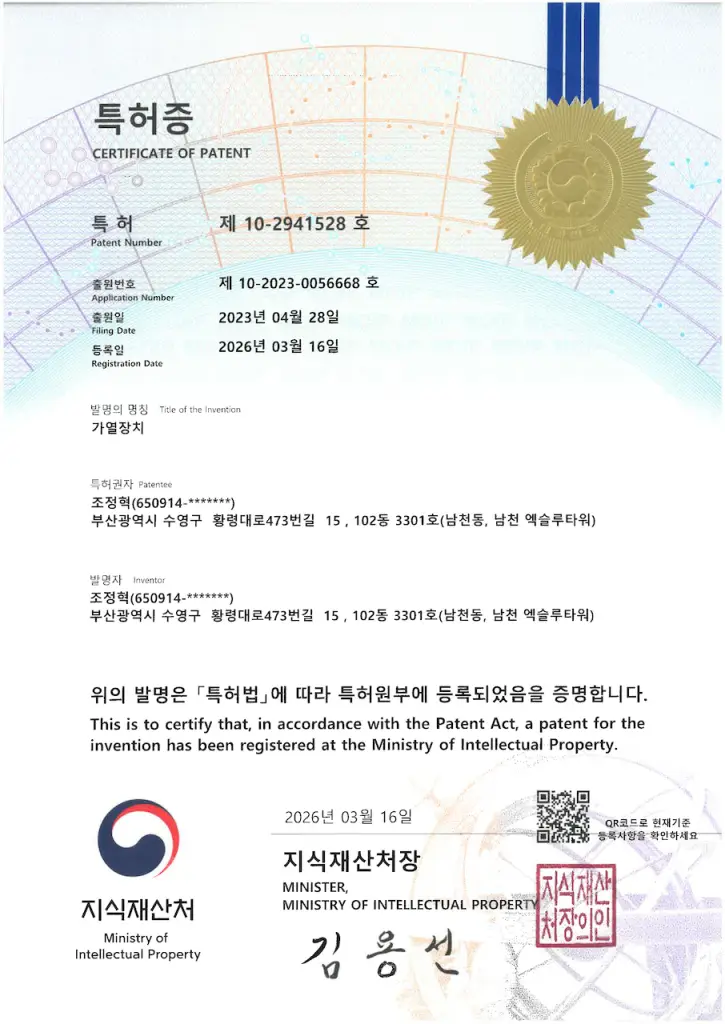
Donghwa Hitech is pleased to announce that we have officially completed the patent registration in South Korea for our induction heating-based “Heating Apparatus”. This technology dramatically improves the pre-heating efficiency of “nozzle packs” (spinneret packs)—a core component of polymer filament manufacturing lines—while drastically reducing energy consumption.
Patent Title: Heating Apparatus (가열장치)
Patent Number: No. 10-2941528
Registration Date: March 16, 2026
Why is an Induction Heating Oven Essential?
To prevent micro-holes from clogging as polymer raw materials cool and solidify, the “nozzle packs” used in the extrusion stage of filament production must be pre-heated to approximately 300°C before being installed into the production machinery.
Traditional ovens rely on electric resistance heaters and complex, bulky internal air ducts to force hot air circulation. These conventional systems take a long time to reach target temperatures, are structurally massive, and run at excessive resistance-coil temperatures of up to 500°C. This extreme heat often causes thermal damage to surrounding machine components and leads to a short, costly replacement cycle for the heating elements themselves.
3 Core Innovation Points of Our New Patented Technology
1. Ultra-Fast directly Heated Vessel Walls for High Thermal Efficiency
The Traditional Limitation: Relying on indirect air circulation loops and resistance coils resulted in slow heating times and substantial heat loss.
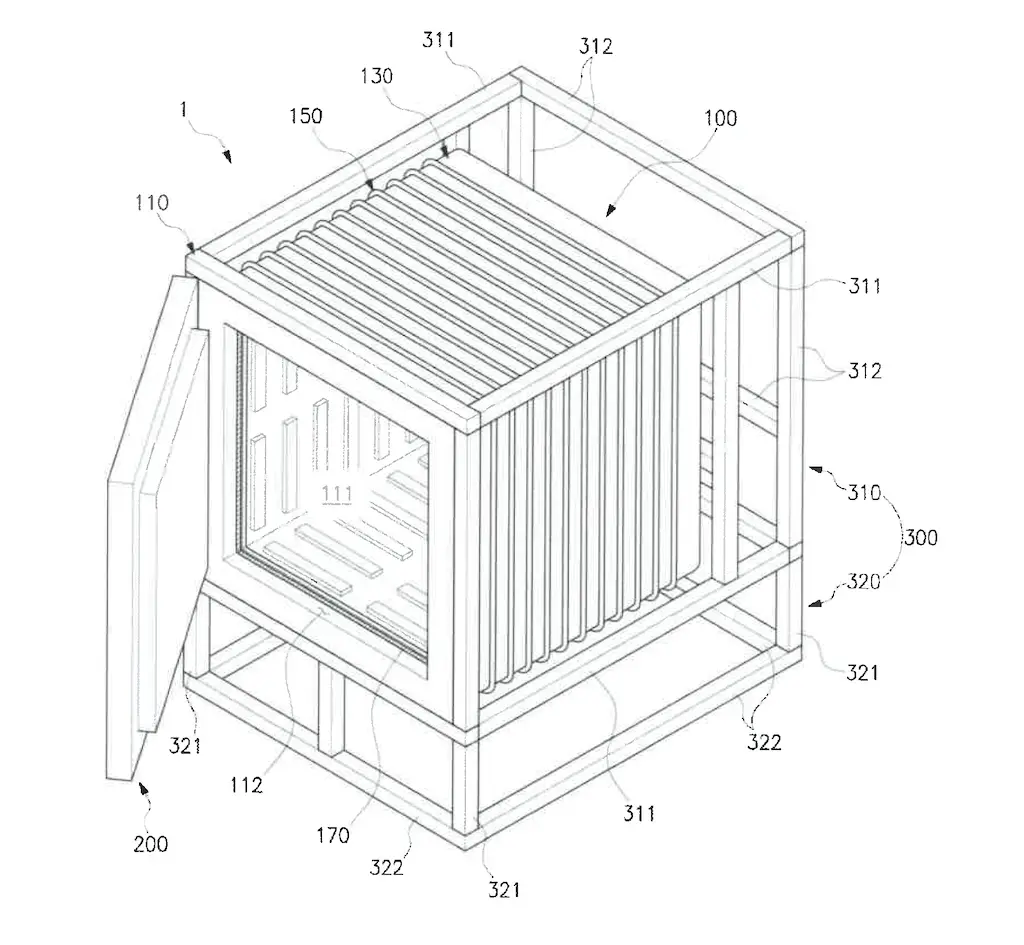
Donghwa Hitech’s Innovation: Our technology constructs the heating chamber itself from a conductive metal (such as SS400) that reacts directly to magnetic fields. By wrapping the insulation and induction coils around the outside of this vessel, the entire chamber wall acts as a direct heat source when powered. This eliminates the need for separate air ducts, allowing for a highly compact oven design that reaches target temperatures (320°C and above) significantly faster.
2. Low-Conductivity Door Frame (SUS310) for Maximum Worker Safety
Safety-First Engineering: The front entry frame (where the door seals against the oven) is manufactured using SUS310, a highly heat-resistant stainless steel with much lower magnetic conductivity than the inner chamber.
Thermal Loss & Burn Prevention: This specialized hybrid construction prevents the outer door frame from heating up via the induction field. It successfully seals heat within the chamber, prevents energy loss, and ensures that operators can safely open and close the door without the risk of accidental contact burns.
3. Maximized Surface Area and Dynamic Forced Convection
Integrated Heat Ribs: The inner top, bottom, and side walls of the heating chamber feature multiple raised, spaced-out metallic protrusions (ribs) to exponentially increase the internal radiant heat transfer area.
Forced 대류 (Convection) Synergy: A high-temperature fan motor assembly mounted inside the rear chamber forces rapid air circulation. As the air flows dynamically between the integrated ribs, it creates an ultra-fast heat exchange with the nozzle pack. This completely eliminates cold spots and maintains a near-flawless temperature uniformity across the target components.
Expected Benefits & Industrial Impact
While categorized under precision textile manufacturing (D01D class), this next-generation thermal platform is highly versatile. It can be easily configured for precision material curing, chemical processing, and delicate electronics drying.
Enhanced Productivity: Reduces critical pre-heating cycles for nozzle packs by over 30%, minimizing machine downtime during pack swap-outs.
Energy Savings: By directly heating the processing chamber rather than over-firing resistance coils, it dramatically lowers factory electricity usage and cuts carbon emissions.
Minimal Maintenance Costs: Unlike traditional systems that require frequent resistance coil replacements, our induction-based design is virtually wear-free, vastly lowering long-term maintenance overhead.